

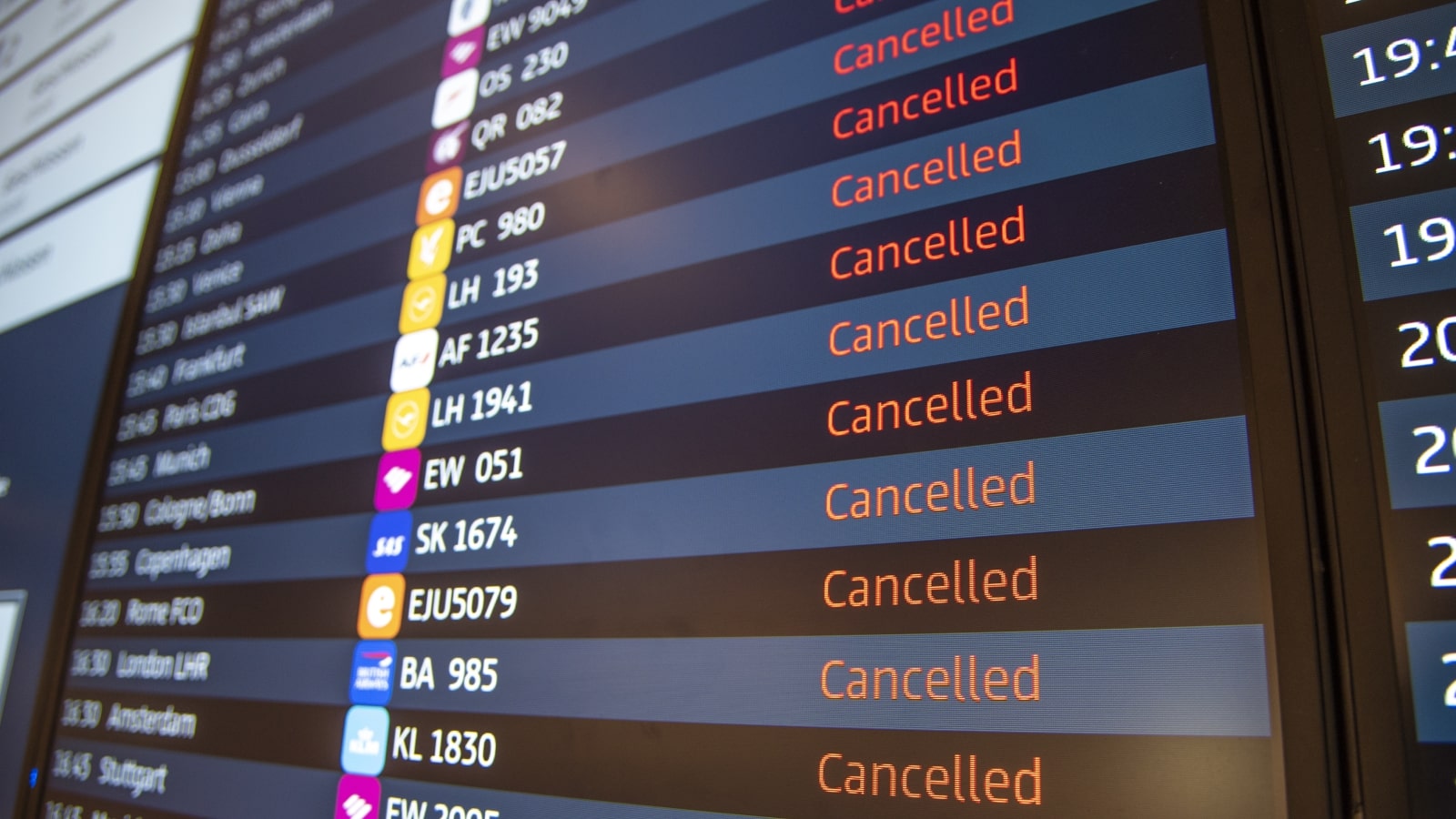
Whilst booking your flight is one of the most exciting aspects of a vacation, flight cancellations remain one of the most frustrating aspects of modern air travel. From unexpected weather disruptions to staffing shortages and technical issues, millions of passengers worldwide experienced last-minute changes to their trips in 2024 and into 2025.
This report highlights the airlines with the highest cancellation rates globally, breaks the data down by region, and explains exactly what passengers are entitled to when their flights are cancelled.
Key Findings on Worldwide Airline Cancellations
🔹 Dana Air recorded the world’s highest cancellation rate in 2024 at 33.9%, though this was driven by its suspension in April after a runway incident in Lagos.
🔹 Indonesia emerged as the hardest-hit country, with four of its carriers appearing in the global top 10 worst performers.
🔹 Travelers in the US and Brazil enjoyed the most reliable skies, with around 70% of US flights and 72% of Brazilian flights arriving on time, the highest punctuality rates worldwide.
🔹 Regional contrasts were stark: while airlines in parts of Africa and Asia struggled to keep flights running, carriers in North and South America delivered far stronger performance.
🔹 Millions of passengers were affected globally, underlining the financial and emotional impact of cancellations and the importance of knowing refund rights.
Top 10 Airlines with the Most Flight Cancellations Worldwide (2024)
The following list shows the worst-performing airlines globally, ranked by the percentage of cancelled scheduled flights during 2024.
| Airline | Region | Country | Total Flights | Cancellation Rate |
| Dana Air | Middle East and Africa | Nigeria | 2,396 | 33.9% |
| Lion Air | Asia Pacific | Indonesia | 125,550 | 16.7% |
| Wings Air | Asia Pacific | Indonesia | 62,176 | 16.3% |
| Air Austral | Middle East and Africa | France (Réunion) | 7,628 | 14.9% |
| Chongqing Airlines | Asia Pacific | China | 57,868 | 14.8% |
| Super Air Jet | Asia Pacific | Indonesia | 89,453 | 14.7% |
| Air Seychelles | Middle East and Africa | Seychelles | 16,069 | 10.1% |
| Batik Air | Asia Pacific | Indonesia | 97,320 | 9.4% |
| China Express Airlines | Asia Pacific | China | 131,928 | 7.7% |
| Winair | Latin America | Netherlands | 25,802 | 6.3% |
Regional Breakdown of Airline Cancellations in 2024
Total Global Flight Cancellations by Region
| Region | Total Flights | Total Cancelled Flights | Cancellation Rate |
| Middle East & Africa | 2,758,152 | 26,793 | 0.97% |
| Latin America | 2,898,438 | 42,407 | 1.46% |
| Europe | 8,528,261 | 90,134 | 1.06% |
| Asia Pacific | 12,489,263 | 315,317 | 2.53% |
| North America | 9,925,300 | 135,744 | 1.37% |
The data reveals striking differences in airline reliability across the globe in 2024.
- Asia Pacific recorded the highest cancellation rate at 2.53%, driven by a combination of extreme weather events, infrastructure bottlenecks, and labour shortages in several key markets. With more than 315,000 flights cancelled, this was by far the largest absolute number of disrupted journeys worldwide.
- Latin America followed with a 1.46% cancellation rate, with nearly 42,500 flights grounded. While overall reliability remains stronger than Asia Pacific, infrastructure challenges and operational issues contributed to elevated disruption across the region.
- North America’s cancellation rate stood at 1.37%, equating to more than 135,000 cancellations. This reflects a complex mix of factors, from winter storms to capacity issues in the U.S.
- Europe registered a 1.06% cancellation rate, representing over 90,000 cancellations. Despite summer strikes and air traffic control pressures, European airlines still managed to maintain relatively strong reliability compared to most other regions.
- The Middle East & Africa reported the lowest cancellation rate globally at just 0.97%, with fewer than 27,000 flights cancelled out of nearly 2.8 million. Flag carriers in the Gulf and well-resourced African hubs contributed to the region’s resilience.
Taken together, these figures show that while Europe and the Middle East & Africa performed best on reliability, passengers in the Asia Pacific faced cancellations at more than double the global average, highlighting how uneven the travel experience remains depending on where you fly.
North America – Which Airlines Cancelled the Most Flights?
| Airline | Total Flights | Total Cancelled Flights | Cancellation Rate |
| American Airlines | 2,177,418 | 28,649 | 1.31% |
| United Airlines | 1,619,100 | 26,704 | 1.64% |
| Delta Air Lines | 1,713,598 | 17,959 | 1.04% |
| Air Canada | 386,082 | 10,816 | 2.80% |
| Southwest Airlines | 1,452,197 | 9,041 | 0.62% |
| Alaska Airlines | 434,662 | 6,301 | 1.44% |
| WestJet | 192,323 | 6,131 | 3.18% |
| Cape Air | 83,101 | 5,069 | 6.09% |
| JetBlue | 324,442 | 4,316 | 1.33% |
| Frontier Airlines | 221,387 | 3,678 | 1.66% |
The North American market shows significant variation in reliability, with major U.S. carriers performing relatively well while smaller regional and Canadian airlines struggled more in 2024.
- Cape Air recorded the highest cancellation rate by far at 6.09%, meaning more than one in twenty flights never took off. As a regional operator, Cape Air is especially exposed to weather and operational disruptions that ripple quickly through its smaller network.
- Among larger carriers, Air Canada (2.80%) and WestJet (3.18%) stood out for higher cancellation rates, reflecting the impact of winter weather, crew shortages, and operational challenges across Canadian airports.
- United Airlines posted a 1.64% cancellation rate, higher than both American (1.31%) and Delta (1.04%). United’s larger international footprint left it more vulnerable to cross-border disruptions.
- Southwest Airlines delivered the lowest cancellation rate at just 0.62%, bouncing back from its high-profile operational meltdown in late 2022 and showing improvements in reliability across 2024.
Overall, the picture is mixed: while U.S. legacy carriers and Southwest kept cancellation rates close to or below 1.5%, Canadian carriers and regional airlines like Cape Air posted significantly higher levels of disruption. For travellers, this underlines the importance of knowing their rights, especially when booking with airlines operating in weather-prone regions.
Useful Links
Asia Pacific – Which Airlines Cancelled the Most Flights?
| Airline | Total Flights | Total Cancelled Flights | Cancellation Rate |
| China Eastern Airlines | 861,628 | 29,786 | 3.45% |
| China Southern Airlines | 813,183 | 25,659 | 3.15% |
| Air China | 612,920 | 23,359 | 3.81% |
| Lion Air | 125,550 | 20,910 | 16.65% |
| Super Air Jet | 89,453 | 13,140 | 14.68% |
| Shenzhen Airlines | 277,688 | 12,812 | 4.61% |
| China Express Airlines | 131,928 | 10,165 | 7.70% |
| Wings Air | 62,176 | 10,125 | 16.28% |
| Batik Air | 97,320 | 9,168 | 9.42% |
| Chongqing Airlines | 57,868 | 8,572 | 14.81 |
The Asia Pacific market showed some of the highest cancellation rates worldwide, with several Indonesian and Chinese carriers driving disruption across 2024.
- Lion Air topped the list with a cancellation rate of 16.65%, meaning roughly one in six scheduled flights never departed. This exceptionally high figure reflects persistent operational challenges in Indonesia’s aviation sector.
- Other Indonesian carriers also fared poorly, including Wings Air (16.28%), Chongqing Airlines (14.81%), and Super Air Jet (14.68%), all cancelling more than one in seven flights. Together, these airlines pushed Indonesia into the spotlight as one of the hardest-hit countries for air travel reliability.
- Among China’s “big three,” Air China posted the highest cancellation rate at 3.81%, followed by China Eastern (3.45%) and China Southern (3.15%). While these percentages are lower than Indonesia’s figures, they still represent tens of thousands of disrupted flights given their vast networks.
- Shenzhen Airlines (4.61%) and China Express (7.70%) further highlight the scale of cancellations in China, especially among mid-sized and regional operators.
- Batik Air cancelled nearly 1 in 10 flights (9.42%), adding to Indonesia’s poor performance in the region.
Overall, Asia Pacific had some of the most volatile cancellation rates globally. Unlike Europe and North America, where most major carriers stayed under 2%, the region saw multiple airlines exceeding 10% cancellation rates, underscoring the uneven reliability of carriers across Asia. For passengers, this translates to a greater risk of disruption, particularly when flying with certain Indonesian and Chinese airlines.
Useful Links
Europe – Which Airlines Cancelled the Most Flights?
| Airline | Total Flights | Total Cancelled Flights | Cancellation Rate |
| Lufthansa | 419,682 | 12,220 | 2.91% |
| British Airways | 310,631 | 7,117 | 2.29% |
| EasyJet | 569,574 | 5,783 | 1.01% |
| KLM | 259,837 | 5,030 | 1.93% |
| Wideroe | 118,725 | 4,438 | 3.73% |
| Air France | 280,774 | 3,802 | 1.35% |
| Turkish Airlines | 422,154 | 3,726 | 1.15% |
| Ural Airlines | 61,021 | 2,938 | 4.81% |
| Ryanair | 1,068,131 | 2,932 | 0.27% |
| Eurowings | 166,789 | 2,658 | 1.59% |
Europe’s major carriers generally delivered lower cancellation rates than Asia Pacific, but there were still some clear outliers and notable regional differences in 2024.
- Ural Airlines recorded the highest cancellation rate at 4.81%, meaning nearly one in 20 flights failed to operate — the worst performer in the European dataset.
- Widerøe (3.73%) and Lufthansa (2.91%) also stood out for higher cancellation rates, with Lufthansa alone scrapping over 12,000 flights across the year.
- British Airways cancelled 2.29% of flights, equating to more than 7,000 cancellations, while KLM posted a lower rate of 1.93% but still disrupted over 5,000 journeys.
- On the stronger side, Ryanair achieved an exceptionally low cancellation rate of just 0.27%, despite operating over one million flights — highlighting the airline’s operational resilience.
- EasyJet also performed well at 1.01%, particularly given its scale as one of Europe’s largest short-haul operators.
- Turkish Airlines (1.15%) and Air France (1.35%) both maintained cancellation rates close to 1%, suggesting relatively stable operations despite ongoing air traffic control and strike pressures in parts of Europe.
Overall, Europe saw fewer extreme cancellation rates than Asia Pacific, but the differences between carriers were still significant. While Ryanair and EasyJet demonstrated strong reliability, legacy airlines such as Lufthansa and British Airways had noticeably higher levels of disruption a reminder that size and reputation don’t always translate to smoother operations.
Useful Links
- Popular destinations in the United Kingdom
- Popular destinations in France
- Popular destinations in Spain
Latin America – Which Airlines Cancelled the Most Flights?
| Airline | Total Flights | Total Cancelled Flights | Cancellation Rate |
| Azul | 322,044 | 10,614 | 3.29% |
| LATAM Airlines | 554,099 | 8,222 | 1.51% |
| Avianca | 263,209 | 4,884 | 1.85% |
| Aerolineas Argentinas | 111,080 | 2,737 | 2.46% |
| Gol | 211,959 | 2,589 | 1.22% |
| Winair | 25,802 | 1,627 | 6.30% |
| Copa Airlines | 125,543 | 1,594 | 1.26% |
| Volaris | 164,988 | 1,515 | 0.91% |
| Aeromexico | 196,999 | 1,334 | 0.67% |
| VivaAerobus | 160,687 | 1,183 | 0.73% |
Latin America’s aviation market showed a broad spread of cancellation rates in 2024, with some carriers maintaining strong operational reliability while others struggled with higher disruption levels.
- Winair posted the highest cancellation rate in the region at 6.30%, cancelling more than one in 16 scheduled flights. Although operating on a smaller scale, this figure highlights the vulnerability of regional carriers to weather and logistical challenges.
- Among larger airlines, Azul had the weakest performance with a 3.29% cancellation rate, scrapping more than 10,600 flights — the highest absolute number of cancellations in Latin America.
- Aerolineas Argentinas also reported elevated cancellations at 2.46%, reflecting ongoing infrastructure and operational pressures in Argentina.
- LATAM Airlines (1.51%) and Avianca (1.85%) sat in the mid-range, cancelling thousands of flights but performing better than Azul and Aerolineas Argentinas.
- At the more reliable end of the spectrum, Mexico’s carriers stood out: Aeromexico (0.67%), VivaAerobus (0.73%), and Volaris (0.91%) all maintained cancellation rates below 1%, the lowest in the region.
- Copa Airlines (1.26%) and Gol (1.22%) also kept disruption relatively low, providing a stable service compared with some of their South American counterparts.
Overall, Latin America’s picture in 2024 was one of contrasts: while Mexico’s airlines led the region for reliability with consistently low cancellation rates, Brazilian carrier Azul and Argentina’s flag carrier faced some of the highest disruption levels.
Useful Links
Middle East & Africa – Which Airlines Cancelled the Most Flights?
| Airline | Total Flights | Total Cancelled Flights | Cancellation Rate |
| Kenya Airways | 46,578 | 2,263 | 4.85% |
| Air Seychelles | 16,069 | 1,624 | 10.10% |
| Ethiopian Airlines | 151,543 | 1,622 | 1.07% |
| Air Algerie | 78,360 | 1,560 | 1.99% |
| Flydubai | 120,169 | 1,220 | 1.01% |
| Air Austral | 7,628 | 1,139 | 14.93% |
| Air Peace | 28,819 | 1,051 | 3.64% |
| Emirates | 172,247 | 836 | 0.48% |
| Iraqi Airways | 27,960 | 830 | 2.96% |
| Dana Air | 2,396 | 813 | 33.93% |
Airlines across the Middle East and Africa showed some of the widest variation in cancellation rates globally, with world-class reliability from certain Gulf carriers contrasting sharply with extreme disruption at smaller African operators.
- Dana Air recorded the region’s (and the world’s) highest cancellation rate at 33.93%, though this figure was heavily influenced by the airline’s suspension in April 2024 following a runway incident in Lagos.
- Air Austral (14.93%) and Air Seychelles (10.10%) also posted double-digit cancellation rates, cancelling more than one in 10 flights across the year — among the highest in any region.
- Kenya Airways cancelled 4.85% of flights, a rate significantly higher than the regional average, reflecting operational challenges across East Africa.
- Air Peace (3.64%) and Iraqi Airways (2.96%) also saw elevated cancellation rates compared to global peers.
- At the other end of the spectrum, the Gulf carriers performed exceptionally well. Emirates cancelled just 0.48% of flights, one of the lowest rates worldwide, while Flydubai also kept disruption low at 1.01%.
- Ethiopian Airlines (1.07%) and Air Algerie (1.99%) delivered moderate cancellation levels, keeping close to the 1–2% range seen in Europe and North America.
Overall, the Middle East & Africa region highlights a tale of two extremes: global reliability leaders like Emirates and Flydubai kept cancellations under 1%, while smaller regional operators struggled with double-digit disruption rates, leaving passengers facing some of the most unpredictable experiences in global aviation.
Useful Links
What Are Your Rights If Your Flight Is Cancelled?

United States
In the U.S., passengers are legally entitled to a cash refund if their flight is cancelled and they choose not to travel. This applies whether the cancellation is caused by the airline, weather, or other disruptions. Recent Department of Transportation (DOT) rules also require airlines to issue refunds automatically in qualifying cases, and always back to the original form of payment rather than vouchers. Passengers can escalate complaints to the DOT if refunds are delayed or denied.
United Kingdom & European Union
Under UK261 and EU261 regulations, travellers whose flights are cancelled are entitled to a refund or rerouting, plus potential fixed compensation of €250–€600 depending on flight distance, unless the airline can prove the cancellation was due to “extraordinary circumstances” (such as severe weather or air traffic control strikes). Compensation is paid in addition to a refund, making EU and UK rules among the strongest worldwide.
Australia
In Australia, rights fall under the Australian Consumer Law (ACL). If a service, such as a flight, is not provided within a “reasonable time,” passengers may be entitled to a refund or replacement service, regardless of whether the airline has offered credit. The ACCC (Australian Competition and Consumer Commission) enforces these rules, giving consumers leverage if an airline refuses to process a legitimate refund.
Other Regions
Consumer protection rules outside the U.S., EU/UK, and Australia vary widely. In some parts of Asia, Latin America, and Africa, passengers often face less formalised protections, leaving them more dependent on airline policies. However, many carriers voluntarily follow international best practices by offering refunds or rebooking options. Where laws are weaker, passengers are advised to check the national aviation authority guidance and keep thorough records when pursuing refunds.
How to Get a Refund – Step by Step
1. Contact the airline directly
Start by reaching out to the airline’s customer service team as soon as you’re informed of the cancellation. Request your refund clearly and in writing (email or web form is best) so there’s a paper trail. Be specific: ask for a cash refund to your original form of payment, not a voucher, unless you’re happy with credit.
2. Keep detailed records
Save booking confirmations, cancellation notices, and all correspondence. Make a note of dates, times, and the names of airline representatives you speak with. These records are essential if you need to escalate your claim later.
3. If you booked through a travel agent or third-party site
Your rights don’t change if you booked via a travel agent, online travel agency, or comparison site — the airline is still responsible for issuing a refund. However, in practice, you may need to go through the agent first, so keep pressure on both parties until the money is returned.
4. Escalate if necessary
If the airline delays or refuses a refund, escalate your complaint to the relevant consumer protection authority:
- U.S.: Department of Transportation (DOT)
- UK: Civil Aviation Authority (CAA)
- EU: National enforcement bodies under EC261
- Australia: Australian Competition and Consumer Commission (ACCC)
These regulators can pressure airlines to comply, and in some cases, allow passengers to pursue compensation.
5. Use your credit card company as a backup
If the airline or agent refuses to act, passengers who paid by credit card may be able to file a chargeback claim with their card provider. This can be an effective last resort, especially if the airline is unresponsive.
6. Be cautious with travel credits
Airlines often push vouchers or flight credits instead of cash. While these can be convenient if you know you’ll rebook soon, credits usually come with expiry dates and restrictions. Opt for cash unless a voucher genuinely works best for your plans.
7. Consider travel insurance
If your policy covers cancellations (not all do), it can provide an extra layer of protection when airlines or agents are slow to refund. Check your policy carefully, especially for exclusions.
Conclusion – What Travellers Can Expect in 2025

Cancellations remain a reality of global travel, but by knowing which airlines have struggled most in the past year, passengers can make more informed booking decisions.
While weather and operational challenges will continue to cause disruption, travellers who understand their refund rights and who book with flexibility will be better placed to avoid financial loss when plans go wrong.
Travala continues to track global travel trends to help travellers make smarter choices, whether booking with traditional currency or crypto.
Methodology – How This Report Was Compiled
This report uses publicly available aviation data to rank airline cancellations.
Note: Regional transparency varies, and not all countries report cancellations in a standardised way. Rankings focus on airlines and markets with reliable published data.
